
Introduction
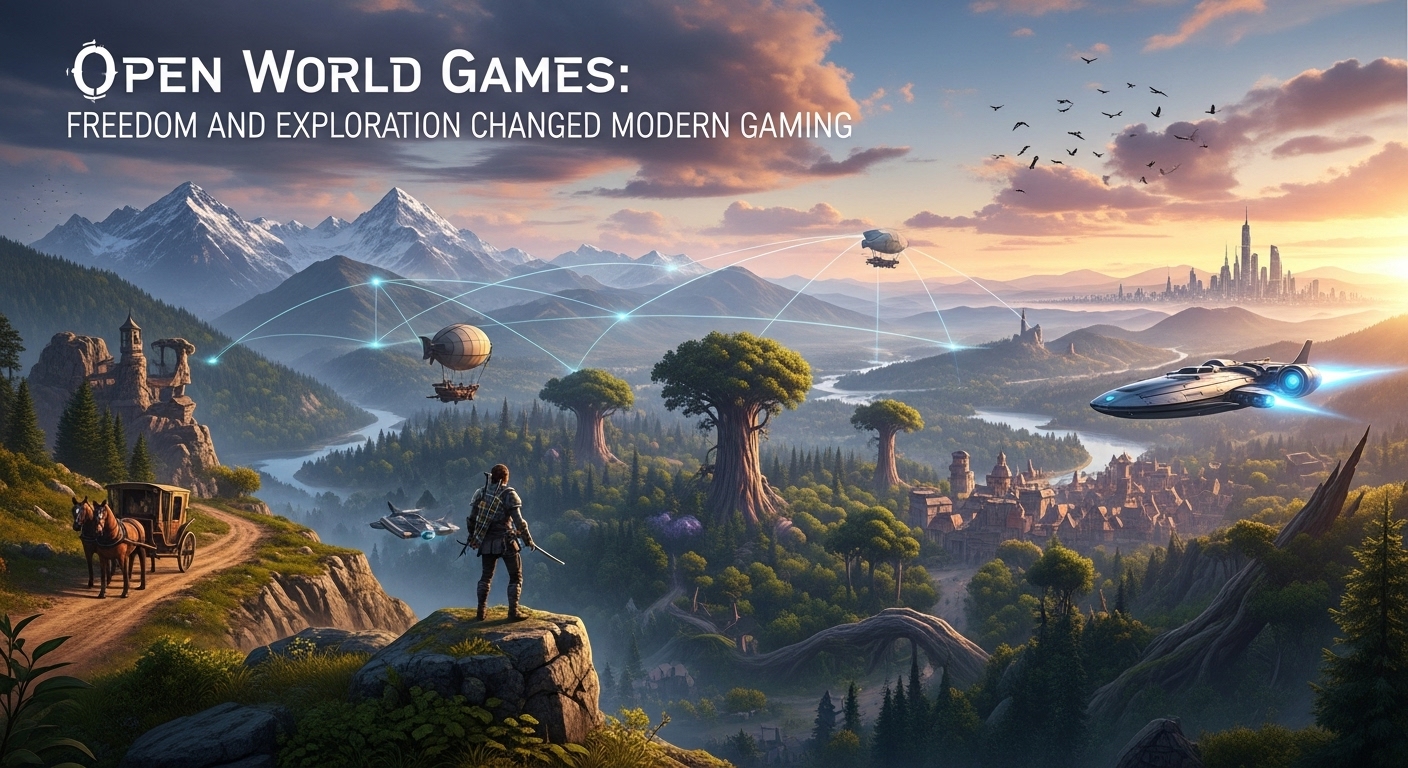
Open world games have redefined what it means to play a video game. Unlike traditional linear games, open world titles give players the freedom to explore vast environments, make choices that affect the story, and experience worlds on their own terms. From Grand Theft Auto III to Elden Ring, open world games have become a central pillar of the modern gaming industry.
This blog will dive deep into the history, mechanics, cultural impact, and future of open world gaming, illustrating why these games resonate so strongly with players worldwide.
The Early Days of Open World Games
The Sandbox Concept
The term “sandbox” describes games that allow players to create their own experiences without strict objectives. Early examples include:
- Elite (1984) – Pioneered open space exploration.
- The Legend of Zelda (1986) – Allowed non-linear exploration and problem-solving.
Grand Theft Auto III: A Revolution
Released in 2001, GTA III set a new benchmark. Players could explore Liberty City freely, engage in side missions, or simply experiment with the environment. This freedom became the defining characteristic of open world games.
Core Features of Open World Games
- Freedom of Exploration – Players can roam without constraints.
- Dynamic Environments – Worlds that react to player actions.
- Multiple Quest Paths – Side missions, story arcs, and hidden content.
- Immersive Lore – Rich stories embedded in the world itself.
Iconic Open World Titles
- The Elder Scrolls V: Skyrim – Fantasy epic with limitless exploration.
- The Witcher 3: Wild Hunt – Complex narrative woven into a living world.
- Minecraft – Sandbox creativity at its peak.
- Red Dead Redemption 2 – Attention to detail and realism redefine immersion.
- Elden Ring – Merges open world exploration with challenging combat.
The Psychology Behind Open World Games
- Player Autonomy – Freedom enhances engagement.
- Curiosity and Discovery – Hidden secrets reward exploration.
- Choice and Consequence – Players feel their decisions matter, increasing emotional investment.
- Achievement and Completionism – Collecting items, unlocking skills, and completing quests trigger dopamine responses.
The Technical Challenges
- Rendering Large Worlds – Requires advanced streaming and memory management.
- AI Behavior – NPCs must interact convincingly in dynamic environments.
- Balancing Freedom and Storytelling – Too much freedom can dilute narrative impact.
- Performance Optimization – Large worlds challenge consoles, PCs, and even mobile devices.
Cultural and Social Impact
- Player Communities – Sharing secrets, mods, and strategies online.
- Esports and Speedrunning – Games like GTA and Skyrim inspire speedrunning competitions.
- Influence on Other Media – Open world mechanics inspire film, VR, and tabletop design.
The Future of Open World Games
- AI-Generated Worlds – Procedural generation for limitless exploration.
- VR Open Worlds – Immersive worlds players can inhabit physically.
- Cross-Platform Play – Shared worlds across PC, console, and mobile.
- Integration of Multiplayer – Massive shared universes where thousands can interact.
Conclusion
Open world games represent the ultimate evolution of player freedom. By combining exploration, narrative, and dynamic environments, they deliver experiences unmatched by linear games. As technology advances, the possibilities for open worlds will expand even further, ensuring they remain a cornerstone of gaming.